


 #HimaEcoMedia
Fadi Ghanem
Solid waste management remains one of the most pressing environmental challenges facing modern societies, given its direct impact on public health, natural resources, and biodiversity. Among the most harmful practices is the indiscriminate dumping of waste, which contributes to soil, water, and air pollution, degrades landscapes, and increases the economic burden associated with waste collection and treatment. In this context, Jordan’s executive program to combat littering emerges as a key environmental initiative, designed to address this issue through an integrated vision that combines modern environmental management, infrastructure development, enforcement mechanisms, and community awareness.
An Integrated Environmental Vision to Combat Littering
The Government of Jordan has launched the Executive Program of the National Cleanliness Strategy and Anti-Littering Plan for 2026–2027, aiming to achieve a qualitative shift in public cleanliness management and environmental protection across all governorates. The program is built on a comprehensive approach structured around four main pillars: legislation and regulation, technical measures, monitoring and enforcement, and public awareness.
It seeks to improve waste management in streets, public spaces, natural areas, tourist destinations, and forests, while safeguarding natural resources and reducing soil and groundwater contamination—ultimately enhancing public health and quality of life.
The program also includes strengthening waste management infrastructure by increasing the number of containers, improving collection, transportation, and treatment systems, and deploying modern technologies to monitor environmental violations, including electronic systems and surveillance cameras to detect illegal dumping.
A Nationwide Field Campaign to Promote Public Cleanliness
As part of this executive program, the Ministry of Environment of Jordan, in cooperation with municipalities, security agencies, and local communities, has launched a series of large-scale field campaigns to promote cleanliness and reduce negative behaviors associated with littering.
Among the most notable initiatives is the “Clean Road” campaign, launched in Amman, which aims to raise environmental awareness and encourage citizens to adopt responsible environmental practices.
In parallel, the Ministry is supporting municipalities and enhancing sanitation infrastructure by distributing hundreds of waste containers across governorates, as well as in tourist and archaeological areas, contributing to reduced littering and improved urban and environmental landscapes.
These efforts have also included extensive clean-up campaigns in forests and ecologically sensitive areas, such as sites near dams and natural reserves, focusing on removing accumulated waste and reinforcing awareness of ecosystem protection.
Recognizing the Leadership of the Ministry of Environment
Within this framework, the Ministry of Environment of Jordan stands out as a leading institutional model in advancing environmental action at both national and field levels. Through this executive program, it has successfully transitioned from a conventional waste management approach to a comprehensive strategic model based on scientific planning, good governance, and effective implementation.
The leadership of Ayman Suleiman has been instrumental in steering these efforts, by promoting a clear vision that bridges policy and practice and strengthens coordination among relevant stakeholders, including ministries, municipalities, and regulatory bodies.
This performance reflects the Ministry’s ability to transform environmental challenges into opportunities for reform and development by introducing modern monitoring tools, activating accountability mechanisms, and implementing field initiatives with tangible impact on citizens’ daily lives. Beyond immediate improvements, these efforts contribute to building a sustainable institutional culture that elevates environmental protection as a national priority, positioning Jordan as a regional model for integrated waste management and the transition toward a circular economy.

Civil Society as a Partner in Promoting Environmental Culture
Civil society plays a fundamental role in the success of these efforts. No environmental policy can achieve its objectives without the active engagement of citizens, non-governmental organizations, educational institutions, and media actors. Building environmental awareness is a cumulative, long-term process that begins in schools and extends into everyday behavior, ultimately becoming embedded in the broader social culture.
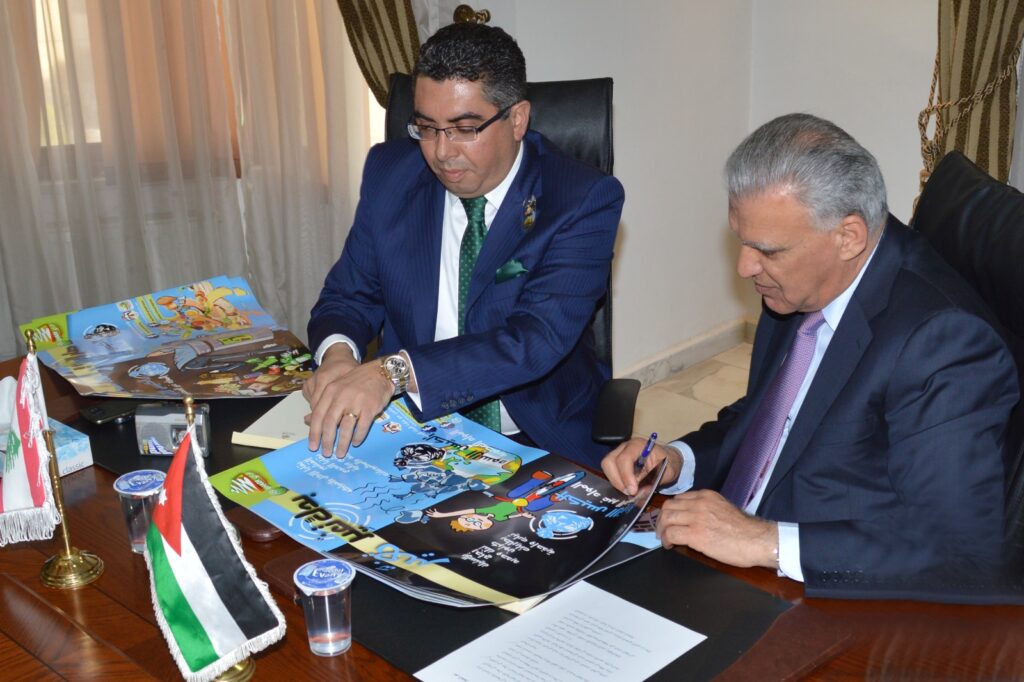
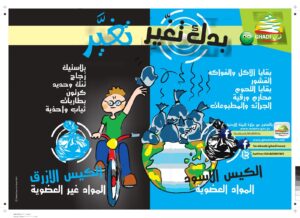
In this regard, pioneering experiences have emerged, notably those led by the Ghadi Association. One key initiative, launched in 2016 in collaboration with former Jordanian Minister of Environment Taher Al Shakhshir, aimed to introduce waste sorting at source within educational institutions. This initiative significantly strengthened environmental education among students by linking theoretical knowledge with daily practice, fostering a more environmentally responsible and sustainability-oriented generation.
Furthermore, the Ghadi Association established a formal framework for cooperation with the Ministry of Environment of Jordan through a partnership agreement focused on knowledge exchange and the promotion of awareness and educational programs in sustainable waste management. Building on this trajectory, the Association reaffirms its readiness to place its expertise and capacities at the service of Jordan’s national efforts, reinforcing the complementarity between government action and community initiatives.
Such examples demonstrate that civil society is not merely a supporter of government efforts, but an active partner in shaping and disseminating environmental culture, capable of driving behavioral change and strengthening the concept of environmental citizenship toward more responsible and sustainable societies.
Toward a Sustainable Environmental Culture
Reducing littering is not achieved solely through laws and enforcement; it fundamentally requires a shift in societal behavior and the cultivation of a deeply rooted environmental culture based on respect for nature and the preservation of resources for future generations.
Jordan’s executive program represents a significant step in this direction, combining scientific planning, field implementation, and community awareness, while fostering collaboration among government entities, civil society, educational institutions, and the media.
In light of the growing environmental challenges facing the Arab region, such initiatives stand as a compelling example of the importance of collective action in building a more sustainable future—one in which environmental protection evolves from a governmental responsibility into a shared national and societal commitment.
-
-
 مقالات خبراء
UNESCO Advisor Dr. Nazar Hassan Announces Levant Himas, Geoparks and Biosphere Reserves Accelerator 2026 Initiative
14 March 2026 -
 مقالات خبراء
BirdLife International CEO Welcomes the Launch of HimaEcoMedia and “The Earthbound 30×30” Podcast
14 March 2026 -
 مقالات خبراء
وزارة البيئة ركيزة حماية الطبيعة في لبنان
14 March 2026 -
 مقالات خبراء
Tim Badman (IUCN): The Hima Experience Shows How Communities Can Sustainably Manage Nature
13 March 2026 -
 مقالات خبراء
When the World Shakes… Nature Stands Firm
11 March 2026 -
 محليات "أحوال الناس"
حين يهتزّ العالم… تثبت الطبيعة
11 March 2026
-
-
- لا توجد مقالات الأكثر قراءة اليوم